How to Build a Compliance Obligations Register That Actually Works
A compliance obligations register helps businesses understand what they must do, who is responsible, and when action is required. Learn how to build and maintain one.
Every business has responsibilities it cannot afford to overlook.
Some come from laws and regulations. Others come from contracts, operating licences, industry standards, internal policies or agreements with customers and suppliers.
The challenge is rarely knowing that these responsibilities exist. It is keeping track of them as the business grows.
A regulatory filing deadline might be buried in an email. An insurance renewal could be sitting in a spreadsheet. A contract might contain a termination notice requirement that nobody remembers until the renewal date approaches.
When responsibilities are scattered across documents, departments and individual calendars, important obligations can easily be overlooked.
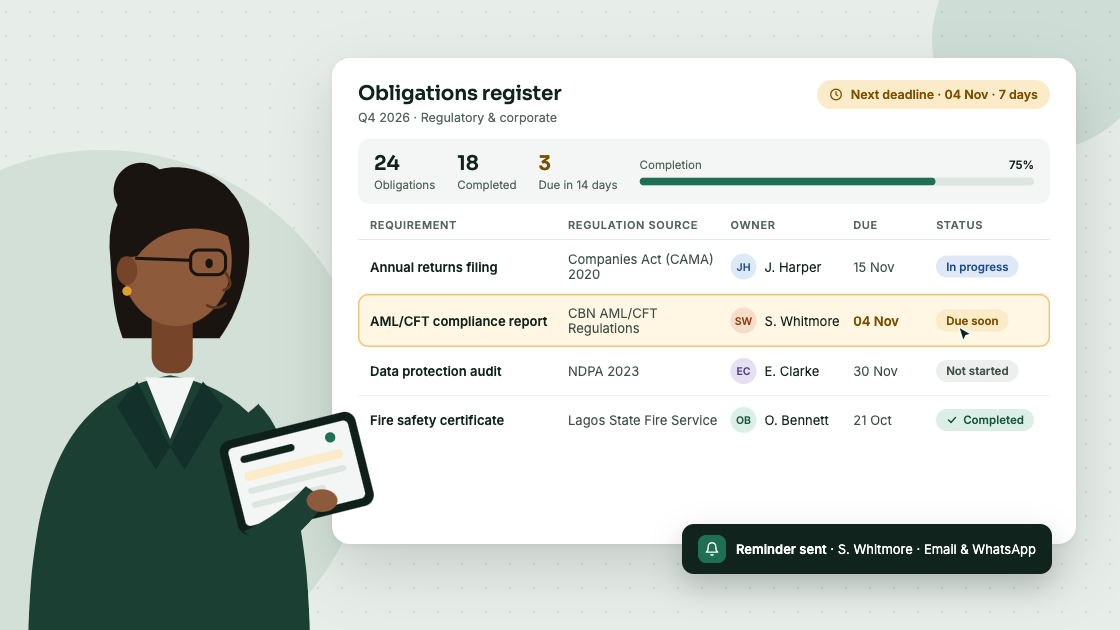
A compliance obligations register brings these responsibilities together.
It provides a structured way to identify what your organization needs to do, understand where each requirement comes from, assign accountability and monitor the work required.
This guide explains what a compliance obligations register is, what it should contain, and how to create one that supports day-to-day operations rather than becoming another spreadsheet nobody maintains.
What Is a Compliance Obligations Register?
A compliance obligations register is a centralized record of the legal, regulatory, contractual and organizational requirements that a business needs to manage.
It is sometimes called a regulatory obligations register, legal obligations register or compliance requirements register.
Its purpose is to answer five questions:
What are we required to do?
Why are we required to do it?
Does the requirement apply to our organization?
Who is responsible for making sure it happens?
How do we know it has been completed?
For example, a business might need to maintain valid operating permits, file statutory returns, review certain policies, renew insurance coverage and complete required employee training.
Instead of managing these activities separately, the business records them in a register that connects each responsibility to its source, owner, deadline and completion status.
A useful register does more than list regulations. It turns requirements into responsibilities that people can act on.
Is a compliance obligations register legally required?
Not every organization is legally required to maintain a document specifically called a compliance obligations register.
However, many regulations impose recordkeeping, documentation or accountability requirements.
For example, Article 30 of the UK GDPR requires many organizations to maintain records of their personal data processing activities. The UK Information Commissioner's Office explains that these records help organizations understand their processing and demonstrate accountability. ICO
A general compliance obligations register is not the same thing as a GDPR record of processing activities, and it does not replace that record.
Nevertheless, maintaining an organized register can help businesses identify, assign and monitor responsibilities arising from applicable regulations.
The exact documentation required will depend on the organization's jurisdiction, activities, industry and circumstances.
Why Your Business Needs a Compliance Obligations Register
As businesses grow, their compliance responsibilities become more complicated.
A small company might initially manage a handful of renewals and filings. A larger organization could have hundreds of requirements spread across departments, locations, regulators and contractual relationships.
Without a structured system, several problems emerge.
1. Important deadlines become difficult to track
Regulatory filings, licence renewals, inspections and certifications may all follow different schedules.
Some occur annually. Others are quarterly, event-driven or dependent on a particular renewal date.
A register helps organizations identify these differences and maintain visibility over upcoming requirements.
2. Nobody knows who is responsible
A compliance requirement may involve several departments.
For example, Finance might prepare a regulatory return, Legal might review the underlying requirement, and an authorized executive might approve the submission.
Without clear accountability, everyone may assume someone else is handling it.
A register should identify the accountable owner and any supporting participants.
3. Requirements become disconnected from their sources
When an employee sees a reminder to complete a compliance activity, they should be able to understand why the activity is necessary.
Linking each obligation to its regulation, contract clause, policy or supporting document provides that context.
It also makes future reviews easier when requirements change.
4. Completed work becomes difficult to verify
Marking a task as completed does not always provide enough information.
A business may need to know when the activity occurred, who completed it, what was submitted and where the supporting records are stored.
A well-maintained register connects completion status to the relevant evidence and activity history.
5. Regulatory changes create uncertainty
Regulations evolve, businesses enter new markets and existing obligations may become applicable or cease to apply.
A register provides a foundation for reviewing these changes and determining whether existing compliance activities need to be updated.
What Should a Compliance Obligations Register Contain?
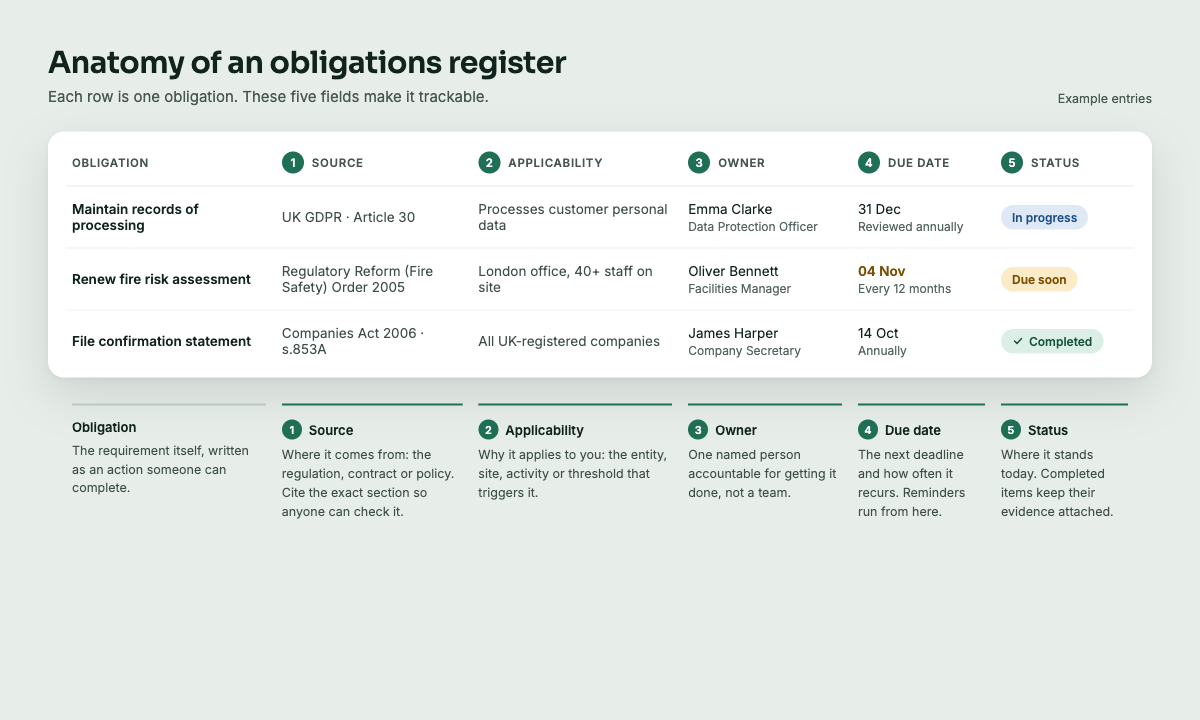
A practical register should contain enough information to make each obligation understandable and actionable.
The following fields provide a useful starting point.
Field | What it records |
|---|---|
Obligation ID | A unique reference for the requirement |
Obligation title | A clear description of what must be done |
Source | The regulation, contract, policy or other document |
Source reference | The relevant section, clause or provision |
Jurisdiction | The country, state or region concerned |
Applicability | Why the requirement applies to the organization |
Responsible owner | The person accountable for the obligation |
Supporting team | Other people involved in completing the work |
Due date | When the requirement must be completed |
Recurrence | Whether the obligation repeats |
Priority | The relative importance or urgency |
Status | Open, in progress, completed or overdue |
Evidence | Supporting documents or records |
Last reviewed | When the requirement was last verified |
Not every obligation will have a fixed due date.
For example, a requirement to maintain appropriate security controls may be continuous, while a regulatory filing might have a specific submission deadline.
Your register should accommodate both.
Important: Do not invent deadlines simply to make every row fit a calendar. Where a legal requirement is continuous or triggered by an event, record that distinction and use appropriate internal review dates.
How to Build a Compliance Obligations Register in 7 Steps
Creating a register does not need to be complicated.
The most important part is establishing a process that keeps the information accurate and useful.
Step 1: Identify the sources of your obligations
Start by gathering the documents and requirements that govern your organization's activities.
These may include legislation, regulatory guidance, operating permits, contracts, insurance policies, employment requirements, internal policies and industry standards.
Employee-related requirements are another important category to consider. Depending on your industry, these may include professional licences, mandatory training, safety certifications and qualification renewals. For a practical approach to identifying and monitoring these responsibilities, read our Employee Credential Monitoring: A Complete Guide for HR Teams.
For each source, record its title, issuing authority, jurisdiction, version or effective date, and where the original document can be accessed.
Use official regulatory sources wherever possible.
Do not assume that a law applies merely because your organization operates in the same country. Applicability may depend on company size, industry, activities, location or other conditions.
Step 2: Extract the actual requirements
Once you have identified the relevant sources, examine them for specific responsibilities.
A useful obligation should describe an action, continuing duty or required outcome.
For example:
Source statement: A contract requires written notice at least 60 days before the agreement's renewal date.
Trackable obligation: Review the agreement and, if the business intends not to renew, send the required notice before the contractual deadline.
This is more useful than creating a vague task called “Review contract.”
The obligation should preserve the source reference and the conditions that determine when action is necessary.
Where the source is complex, a qualified professional should review the interpretation before it becomes part of the organization's compliance process.
Step 3: Determine which requirements apply
Not every requirement identified during research will apply to your business.
Consider the organization's activities, industry, employee count, operating locations, regulated status and contractual relationships.
Classify requirements as applicable, not applicable or requiring further review.
Record the reasoning behind important decisions.
This is especially useful when an auditor, regulator or new compliance officer later needs to understand why a particular requirement was included or excluded.
Step 4: Assign an accountable owner
Every applicable obligation should have someone responsible for coordinating its completion.
The owner does not necessarily perform every task personally.
For example, the Head of Finance might own an annual regulatory filing while an accountant prepares the supporting information.
The register should make this distinction clear.
Avoid assigning critical obligations to generic departments without identifying the person responsible for following through.
Step 5: Define deadlines and recurrence
Different obligations require different scheduling approaches.
A one-time obligation has a specific completion date.
A recurring obligation repeats according to a defined schedule, such as annually or quarterly.
An event-driven obligation becomes due when a particular event occurs.
A continuous obligation remains applicable throughout an activity or operating period.
Consider a UK company's confirmation statement.
Companies House states that companies must review their records and file a confirmation statement at least once every 12 months. The filing deadline is up to 14 days after the review period ends. The exact date depends on the company's circumstances and filing history. GOV.UK
A compliance register should therefore record the company's actual review period and filing deadline rather than assign every UK company the same annual date.
The same principle applies to insurance renewals, contract notice periods and employee certifications.
Step 6: Configure reminders and escalation
A register becomes much more useful when the responsible people receive advance notice of upcoming work.
For an obligation that requires preparation, you might configure reminders:
60 days before the deadline to begin gathering information.
30 days before to review progress.
7 days before to confirm readiness.
On the deadline to confirm completion.
After the deadline to escalate unresolved work.
These intervals are examples of internal workflow settings, not universal regulatory requirements.
The appropriate schedule depends on how long the activity takes, the consequences of delay and the applicable legal or contractual rules.
For continuous obligations, periodic reviews or monitoring activities may be more appropriate than deadline reminders.
Step 7: Record completion and review regularly
A compliance obligations register should remain useful after a task has been completed.
Record who completed the activity, when it was completed and what evidence supports that status.
For recurring obligations, establish the next applicable occurrence.
Also review the register periodically to identify requirements that have changed, obligations without owners, overdue work and records that are no longer applicable.
The objective is to maintain a reliable operational record, not simply accumulate completed tasks.
Compliance Obligations Register Example
Consider a business operating in the United Kingdom and the United States.
Its register might contain the following obligations, subject to the applicability of each requirement.
Obligation | Source | Owner | Schedule | Evidence |
|---|---|---|---|---|
File company confirmation statement | UK Companies House requirements | Company Secretary | Company-specific annual filing deadline | Filing confirmation |
Prepare and post OSHA Form 300A | US OSHA, 29 CFR 1904.32 | HR/Safety Manager | February 1–April 30 posting period, where applicable | Certified summary and posting record |
Review business insurance coverage | Insurance policy and internal procedure | Finance Manager | Based on policy renewal date | Renewal documents |
Review supplier agreement | Supplier contract | Legal Manager | Before contractual notice deadline | Review decision and notice, if applicable |
These examples demonstrate why obligations need individual schedules and supporting context.
OSHA's recordkeeping rules, for instance, require covered employers to complete and certify Form 300A and post it from February 1 through April 30. Applicability depends on factors including establishment size and industry. Separate electronic submission requirements apply to certain establishments. OSHA
A register can help track those responsibilities, but it does not replace the official OSHA records or submission processes.
Similarly, an insurance review date may be an internal management deadline rather than a deadline established by legislation.
Distinguishing between legal requirements, contractual obligations and internal controls makes the register more reliable.
Compliance Obligations Register vs Compliance Calendar
Although these tools are related, they serve different purposes.
A compliance calendar focuses primarily on dates.
It helps answer questions such as what is due this week, which filings are approaching and when a certificate expires.
A compliance obligations register contains broader information.
It explains the underlying responsibility, its source, applicability, owner, recurrence and completion status.
For example, a calendar might show:
March 31 — Annual compliance filing
A register should provide the additional context: which filing, which legal entity, why it applies, who owns it, what information is required and how completion will be verified.
The most effective approach is to connect the calendar to the register.
That way, reminders and deadlines remain attached to the actual obligations.
Can You Manage a Compliance Obligations Register in Excel?
Yes.
For a small organization with relatively few obligations, a spreadsheet can be a reasonable starting point.
It is inexpensive, familiar and flexible.
However, spreadsheets become harder to maintain as the number of obligations, departments and recurring activities increases.
Common challenges include outdated copies, unclear ownership, manually updated deadlines and limited visibility into whether reminders were actually sent.
Spreadsheets also require additional processes to maintain activity histories and connect obligations to supporting documents.
For a growing organization, dedicated obligation management software can help centralize these activities.
The decision should depend on the complexity of your requirements rather than the assumption that every business needs specialized software.
How Remindash Helps You Manage Compliance Obligations
A compliance register becomes more valuable when it is connected to the work required to fulfill each obligation.
Remindash helps businesses turn responsibilities from policies, regulations, contracts and other documents into trackable obligations.
Instead of keeping requirements in one spreadsheet and reminders in another system, organizations can manage the relationship between the requirement, responsible owner, deadline and activity history.
Identify obligations from policies and documents
Remindash provides a Policy & Regulation Library where organizations can review published requirements and decide which apply to their operations.
Its Document Intelligence capability can also identify potential obligations and important dates in uploaded documents.
AI-generated suggestions require human review before they are confirmed and tracked.
Assign ownership and monitor deadlines
With Obligation Management, businesses can connect obligations to their sources, assign responsible owners and monitor upcoming or overdue work.
Recurring obligations can be managed across successive occurrences.
Automate reminders
Remindash supports configurable reminder sequences using email, SMS and WhatsApp, with capabilities depending on the subscription plan.
Organizations can notify responsible people before deadlines and configure escalations for overdue work.
Maintain an activity history
An obligation's activity history helps teams understand when it was created, what changed, which reminders were scheduled and when it was marked complete.
This provides useful operational visibility when reviewing outstanding responsibilities.
Remindash does not determine whether an organization is legally compliant. Businesses remain responsible for confirming applicable requirements, meeting their obligations and obtaining professional advice where appropriate. Remindash
Common Mistakes to Avoid
Even a carefully designed register can become unreliable if it is not maintained properly.
One common mistake is copying requirements from secondary sources without checking the underlying law or regulation.
Another is treating every requirement as an annual deadline, even when the law establishes a different recurrence or an event-based obligation.
Organizations also sometimes record requirements without assigning owners or create reminders without defining the work those reminders are supposed to support.
Finally, a register can become outdated when the business changes activities, enters a new jurisdiction or fails to review amendments to existing regulations.
A reliable register requires ongoing ownership, source verification and periodic review.
Frequently Asked Questions
What is the difference between a compliance register and a risk register?
A compliance obligations register identifies requirements that an organization must or has committed to meet.
A risk register identifies uncertainties, threats or events that could affect organizational objectives.
The two can be connected. For example, failure to renew an operating licence may create regulatory, financial and operational risks.
However, the obligation and the associated risks should remain distinguishable.
How often should a compliance obligations register be reviewed?
There is no single review frequency suitable for every organization.
The appropriate schedule depends on the number of requirements, the rate of regulatory change and the organization's activities.
Businesses should establish periodic reviews and update relevant records when laws, contracts, operations or applicability conditions change.
Who should maintain the compliance obligations register?
Responsibility often sits with a compliance, legal, risk or operations function.
However, individual obligations should have accountable owners within the departments responsible for completing them.
Can a compliance register include contractual obligations?
Yes.
A business may maintain a broader obligations register covering regulatory requirements, contractual commitments and internal policies.
It should clearly identify the source and category of each obligation so that contractual and internal requirements are not misrepresented as statutory duties.
Is a compliance obligations register the same as a legal register?
The terms are sometimes used interchangeably.
A legal register typically focuses on applicable legislation and regulatory requirements, while a broader compliance obligations register may also include contractual and internal commitments.
The exact terminology varies between organizations and industries.
Final Thoughts: Turn Compliance Requirements Into Action
A compliance obligations register should not become another document that is created once and forgotten.
Its real value comes from helping an organization understand what it needs to do, who is responsible, when action is required and what has already been completed.
Start by identifying the relevant sources, confirming applicability and recording the requirements clearly.
Then assign owners, establish appropriate schedules, configure reminders and maintain a reliable history of completed work.
Whether you begin with a spreadsheet or a dedicated system, the goal remains the same: make important responsibilities visible, actionable and easier to manage.
Ready to organize your business obligations?
Get started with Remindash and bring your policies, contracts, deadlines and recurring responsibilities into one place.
Browse the compliance library
Find the regulations and obligations relevant to your organisation.
Browse library