Policy Review Schedule — How to Create, Manage and Automate Policy Reviews
Outdated policies can create confusion and operational risk. Learn how to build a practical policy review schedule with clear ownership, review dates, approval workflows and documented changes.
 13 min read
Your company has an employee handbook, a data protection policy, an information security policy, a health and safety policy and several operating procedures.
But when were they last reviewed?
Who is responsible for keeping them current? What happens when a regulation changes? And how can you demonstrate that a policy was reviewed and approved?
These questions become increasingly difficult as an organization grows.
Policies are often created to address a specific business need, then stored in shared folders or document management systems. Over time, the people responsible for them change, business processes evolve and regulatory requirements may be updated.
Without a structured review process, an organization can end up relying on documents that no longer reflect how it operates.
A policy review schedule helps prevent this.
It establishes when policies should be reviewed, who is responsible, what should be checked and how the outcome should be documented.
This guide explains how to create a practical policy review schedule, choose appropriate review frequencies, manage approvals and use reminders to keep the process moving.
What Is a Policy Review Schedule?
A policy review schedule is a structured plan for periodically examining an organization's policies to determine whether they remain accurate, relevant, effective and appropriate.
It connects each policy to an accountable owner, a review frequency, a next review date and an approval process.
For example, an organization may establish an annual review of its information security policy and a two-year review of its travel and expenses policy.
The schedules may differ because the policies address different risks and operational needs.
A review schedule should also account for events that require an earlier review, such as a regulatory change, significant incident or major organizational restructuring.
A policy review is not necessarily the same as a policy revision.
A review may conclude that the existing policy remains suitable and requires no changes.
The important outcome is a documented decision.
Why Organizations Need a Policy Review Schedule
Policies define expectations, responsibilities and approved ways of working.
When they become outdated, they may no longer align with the organization's activities, systems or applicable requirements.
A structured review process addresses several common problems.
Outdated policies remain in circulation
A policy may refer to an old organizational structure, discontinued software or a process that employees no longer follow.
Without periodic review, these inaccuracies can remain unnoticed.
Regulatory changes are not reflected
Changes in legislation, regulatory guidance or contractual requirements may affect existing policies.
A review process helps organizations identify where updates are necessary.
Nobody owns the policy
A policy without an accountable owner may remain unchanged for years.
Clear ownership ensures that someone is responsible for coordinating its review.
Approvals are difficult to demonstrate
Organizations may need to explain who reviewed a policy, what changes were considered and who approved the current version.
A documented process makes these decisions easier to trace.
Employees may follow different versions
When outdated copies remain accessible, employees may rely on conflicting instructions.
Policy review should therefore include publication and communication of the approved version.
How Often Should Company Policies Be Reviewed?
There is no single review frequency that applies to every organizational policy.
Some organizations use annual reviews as a default. Others establish different frequencies according to risk, regulatory requirements and operational complexity.
The right schedule depends on the specific policy.
The UK Information Commissioner's Office, for example, recommends that organizations review policies and procedures according to documented review dates and update them without undue delay when relevant changes occur.
Its accountability audit guidance also recommends recording policy owners, versions, review dates and change histories. Source: ICO Policies and Procedures.
For workplace safety programs, OSHA recommends periodic program evaluation, at least annually, while recognizing that the appropriate scope and frequency depend on the program's complexity, maturity and hazards. Its guidance also identifies incidents and changes in equipment or processes as potential triggers for additional evaluation. Source: OSHA Program Evaluation and Improvement.
These are context-specific recommendations, not a universal annual review rule for all corporate policies.
Example policy review frequencies
Policy type | Illustrative internal frequency | Additional review triggers |
|---|---|---|
Information security | Every 12 months | Security incident, major technology change |
Data protection | Every 12 months | Regulatory change, new processing activity |
Employee handbook | Every 12 months | Employment law change, organizational restructuring |
Health and safety | Every 12 months | Workplace incident, new equipment or hazards |
Procurement | Every 24 months | Supplier risk change, process redesign |
Travel and expenses | Every 24 months | Financial policy or reimbursement changes |
Business continuity | Every 12 months | Major incident, operational or infrastructure change |
These are suggested organizational review intervals, not legally prescribed deadlines. Applicable laws, standards, contracts and internal commitments may require different schedules.
An organization should document why each frequency was selected and reassess it when circumstances change.
How to Create a Policy Review Schedule in 7 Steps
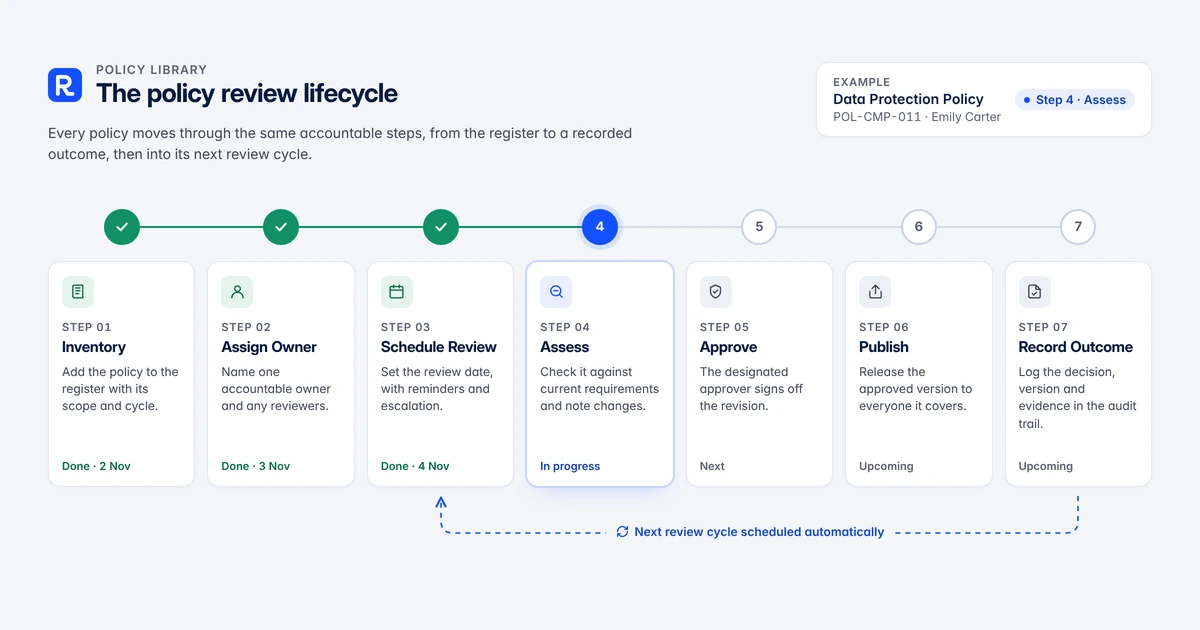
A reliable policy review schedule starts with a complete policy inventory and ends with documented decisions and follow-up actions.
Step 1: Create a central policy register
Begin by identifying the policies your organization currently maintains.
These may include corporate governance policies, HR policies, IT and security policies, financial procedures, procurement policies, health and safety policies, and operational guidelines.
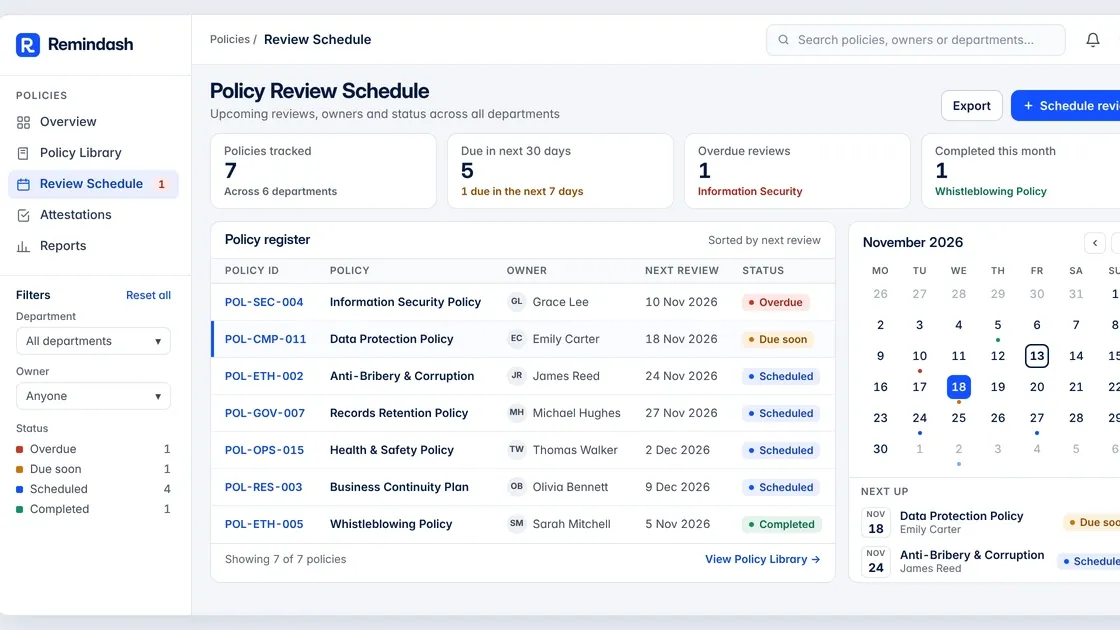
For each document, record its title, department, owner, approval authority, version, effective date and next review date.
A central register helps identify policies that have no owner, have not been reviewed recently or exist in multiple versions.
For organizations already managing regulatory requirements, the policy register can connect to a broader compliance obligations register.
The obligations register records what the organization must do. The policy register identifies the documents that explain or govern how those responsibilities are addressed.
Step 2: Assign a policy owner
Every policy should have an accountable owner.
The owner coordinates reviews, gathers input, proposes changes and ensures that the document moves through the approval process.
For example, the HR Manager may own the employee handbook, while the Head of IT owns the information security policy.
The policy owner does not necessarily have final approval authority.
A board, executive, department head or designated committee may be responsible for approving changes.
Document both roles clearly.
Step 3: Determine the review frequency
Choose a review frequency based on the policy's requirements and risks.
Consider whether a regulation or contract establishes a specific review requirement, how frequently the underlying business process changes, and the potential consequences of outdated instructions.
A policy governing a high-risk operational activity may justify more frequent review than a relatively stable administrative procedure.
Where a legal or contractual review interval exists, record the relevant source.
Where the organization selects its own interval, identify it as an internal governance decision.
Step 4: Establish review dates and preparation milestones
Once the review frequency is agreed, calculate the next review date.
For example, a policy approved on January 15, 2026, with an internally established annual review cycle might have its next review due on January 15, 2027.
However, the owner should begin preparing before that date.
A sample workflow might be:
Timing | Action |
|---|---|
45 days before | Notify policy owner |
30 days before | Gather stakeholder feedback and review source requirements |
21 days before | Prepare proposed changes |
14 days before | Submit draft for review |
7 days before | Obtain approval or escalate outstanding decisions |
Review due date | Record the review outcome |
After approval | Publish the approved version and communicate changes |
These are suggested internal milestones.
For policies requiring board approval or external consultation, the preparation period may need to be longer.
Step 5: Conduct the policy review
The reviewer should examine whether the policy remains accurate, appropriate and aligned with current requirements.
A useful review considers the policy's purpose, scope, legal and regulatory references, assigned responsibilities, operational procedures, effectiveness and relationship to other documents.
Reviewers should also consider feedback from employees, incidents, audits and operational changes.
For example, an information security policy written before an organization adopted cloud services may need updating to reflect new systems, access controls and responsibilities.
The review should result in a clear recommendation: retain the policy unchanged, revise it, replace it or retire it.
Step 6: Obtain approval and publish the current version
Where changes are required, follow the organization's approval process.
Record who reviewed the policy, who approved the changes, when approval occurred and which version became effective.
The approved version should be published in the appropriate location.
Outdated copies should be clearly marked as superseded or removed from active circulation, while preserving records where required.
If changes affect employees' responsibilities, communicate them to the relevant teams and provide training where necessary.
Step 7: Record the outcome and schedule the next review
A policy review is not complete merely because someone opened the document.
Record the review date, reviewer, decision, approval status and any outstanding actions.
Then establish the next review date according to the approved schedule.
If the policy is replaced or retired, update the register accordingly.
A documented history helps future reviewers understand what changed and why.
Policy Review Schedule Template
A simple policy review register might look like this:
Policy | Owner | Last review | Next review | Status |
|---|---|---|---|---|
Information Security Policy | Head of IT | Jan 15, 2026 | Jan 15, 2027 | Scheduled |
Data Protection Policy | Compliance Manager | Mar 1, 2026 | Mar 1, 2027 | Scheduled |
Employee Handbook | HR Manager | Jun 1, 2026 | Jun 1, 2027 | Scheduled |
Procurement Policy | Procurement Manager | Jul 1, 2025 | Jul 1, 2027 | Scheduled |
Health and Safety Policy | Operations Manager | Feb 1, 2026 | Feb 1, 2027 | Scheduled |
All dates, owners and statuses are fictional examples based on assumed internal review cycles.
A more complete register should also include the policy version, approving authority, applicable regulatory or contractual review requirement, document location, review outcome and supporting evidence.
This helps distinguish a scheduled review from a completed and approved review.
Policy Review Checklist
Use this checklist during each review:
Is the policy's purpose still relevant?
Does the scope reflect current business activities?
Are the legal and regulatory references current?
Are the named roles and responsibilities accurate?
Do the procedures reflect actual operations?
Have recent incidents, audits or complaints identified gaps?
Does the policy conflict with another approved document?
Are additional controls, training or communications needed?
Has the appropriate person approved the review outcome?
Have the version, effective date and next review date been updated?
A review should address the substance of the policy, not simply change its date.
Scheduled Reviews vs Event-Triggered Reviews
Periodic reviews provide a predictable governance process.
However, organizations should not wait until the next scheduled date when a significant event makes a policy inaccurate or ineffective.
Common triggers include regulatory changes, serious incidents, audit findings, new business activities, technology changes, mergers, restructuring and changes to contractual requirements.
For example, a data protection policy may need review when the organization begins processing a new category of personal information.
Similarly, an information security incident may reveal a weakness in an existing procedure.
An effective schedule should therefore support both planned reviews and additional reviews triggered by events.
The ICO's guidance specifically recognizes the need to update policies promptly following relevant operational, legal or regulatory changes.
Policy Review vs Policy Approval vs Policy Audit
These activities are related but should not be treated as interchangeable.
Activity | Main purpose |
|---|---|
Policy review | Determine whether the policy remains appropriate and accurate |
Policy revision | Change the policy's content |
Policy approval | Authorize a new or revised policy |
Policy audit | Assess whether the policy and related controls are implemented and effective |
Policy acknowledgment | Record that relevant people received or acknowledged the policy |
A policy can be reviewed without being revised.
A revised policy may require approval before it becomes effective.
An audit may reveal that an approved policy is not being followed.
Acknowledgment demonstrates receipt or acknowledgment, not necessarily understanding or compliance.
Maintaining these distinctions makes the governance process more reliable.
How to Track Policy Reviews Across Departments
As the number of policies increases, organizations need a consistent way to monitor progress.
A useful policy review process should answer several questions:
Which policies are due for review this quarter? Which reviews are overdue? Who owns them? Which proposed changes are awaiting approval? Which approved policies still need to be communicated?
A central calendar provides visibility into upcoming dates.
A policy register provides document information and ownership.
An obligation tracking system can connect review responsibilities to deadlines, reminders and activity history.
For a broader approach to scheduling recurring responsibilities, see our Compliance Deadline Calendar guide.
The most effective process connects these records rather than requiring teams to update several disconnected spreadsheets.
Can You Manage Policy Reviews in Excel?
Yes.
A spreadsheet can work for organizations with relatively few policies and a clearly defined owner.
It can record policy names, review dates, responsible employees and approval statuses.
However, manual tracking becomes more difficult when policies are distributed across departments, reviews involve several approvers and reminders must be repeated over time.
Dedicated obligation management software may help with ownership, recurring review deadlines, notifications and activity tracking.
It is important to distinguish obligation tracking from full policy lifecycle management.
A system that tracks review deadlines does not necessarily provide document editing, formal approval routing, electronic signatures or policy acknowledgment features.
Choose tools based on the capabilities your organization actually needs.
How Remindash Helps You Manage Policy Review Responsibilities
A policy review schedule is most useful when the review dates become responsibilities that people can act on.
Remindash helps organizations connect policies and documents to trackable obligations with owners, deadlines, reminders and activity histories.
Turn policy requirements into obligations
With Policy Obligation Management, teams can review published policy requirements, determine which apply and track relevant responsibilities.
For internal policies, Remindash's Document Intelligence can suggest potential obligations and important dates from uploaded documents.
These suggestions require human review before being confirmed, and document analysis availability depends on workspace enablement.
Assign policy review owners and due dates
Through Obligation Management, organizations can create recurring review responsibilities, assign accountable owners and establish due dates.
For example, a company might create an obligation called “Review Information Security Policy” with the Head of IT as its owner and an internally approved annual recurrence.
Each occurrence can be tracked separately.
Configure reminders and escalation
With Reminders & Sequences, teams can notify policy owners before review deadlines.
Reminders can use supported email, SMS and WhatsApp channels, with escalation and channel availability depending on the organization's plan and configuration.
Maintain activity and source history
Remindash's Activity & Source Evidence capability records changes to obligations and links them to their sources.
This helps teams understand when a review responsibility was created, reassigned or completed.
However, an obligation marked completed does not, by itself, prove that a policy received the necessary formal approval or that its contents are compliant.
Those decisions remain part of the organization's governance process.
Get help organizing policy responsibilities
Organizations that need operational support can also explore Remindash Managed, which provides assistance with document onboarding, obligation setup, reminders and ongoing monitoring.
Remindash supports the organization and monitoring of responsibilities. It does not replace professional judgment, formal governance approvals or legal advice, and it does not guarantee regulatory compliance.
Common Policy Review Mistakes to Avoid
Reviewing every policy on the same schedule
Different policies carry different risks and requirements.
A single annual review date may be convenient but should not replace a considered review frequency.
Updating the review date without reviewing the content
Changing a document's date is not evidence of a meaningful review.
The process should include a substantive assessment and a recorded outcome.
Failing to assign an accountable owner
Without ownership, policies can remain overdue even when several departments are involved.
Ignoring changes between scheduled reviews
Significant legal, operational or organizational changes may require an earlier review.
Publishing revisions without approval
Where formal approval is required, the revised document should not be treated as effective before the appropriate authorization.
Keeping outdated versions in circulation
Employees should be able to identify and access the current approved policy.
Failing to document the review decision
A review that results in no changes should still have a documented outcome.
Frequently Asked Questions About Policy Review Schedules
How often should policies be reviewed?
The frequency depends on the policy, applicable requirements and organizational risk. Annual review is a common internal choice, but not a universal legal requirement. Some policies may need more frequent or event-triggered reviews.
Who is responsible for reviewing company policies?
Each policy should have an accountable owner, usually from the department responsible for its subject matter. Review and final approval may involve different people.
What should a policy review schedule include?
It should identify the policy, owner, last review date, next review date, frequency, approval authority, status and supporting records.
Does every policy need to be revised during a review?
No. A review may conclude that the policy remains appropriate. That decision should still be documented.
What is the difference between a policy review date and an effective date?
The review date indicates when the policy is scheduled to be assessed. The effective date identifies when an approved version becomes operative. They may differ.
Can policy reviews be automated?
Reminders, recurring review tasks and ownership tracking can be automated. The substantive review and required approval decisions still need appropriate human involvement.
Is a policy review schedule legally required?
There is no universal requirement for every organization to maintain a document with that exact name. Specific regulations, standards or contracts may require documented policies, reviews or periodic evaluations. Organizations should verify the requirements applicable to them.
Final Thoughts: Make Policy Reviews a Repeatable Process
A policy review schedule should do more than remind employees that a document exists.
It should establish accountability, provide time for meaningful review and maintain a clear record of decisions.
Start with a complete policy register, assign owners and determine review frequencies based on actual requirements and risks.
Then establish review dates, configure reminders, document outcomes and ensure approved changes reach the people who need them.
The objective is simple: every policy should have an owner, a review plan and a reliable record of what happened.
Keep Policy Review Responsibilities Organized With Remindash
Stop relying on scattered spreadsheets and personal calendars to remember important policy reviews.
With Remindash, you can create recurring review obligations, assign responsible owners, schedule reminders and maintain an activity history.
Explore Remindash Policy Obligation Management and make policy reviews part of a more organized compliance process.
Get hands-on compliance support
Work with Remindash to turn requirements into an operational plan.
This article is general guidance, not legal advice. Which requirements apply depends on your circumstances; review official sources and obtain professional advice where appropriate.