
Employee Credential Monitoring: A Complete Guide for HR Teams
Keeping employee licences, certifications and qualifications up to date is more than an administrative task. It is an important part of workforce readiness, operational safety and compliance management.
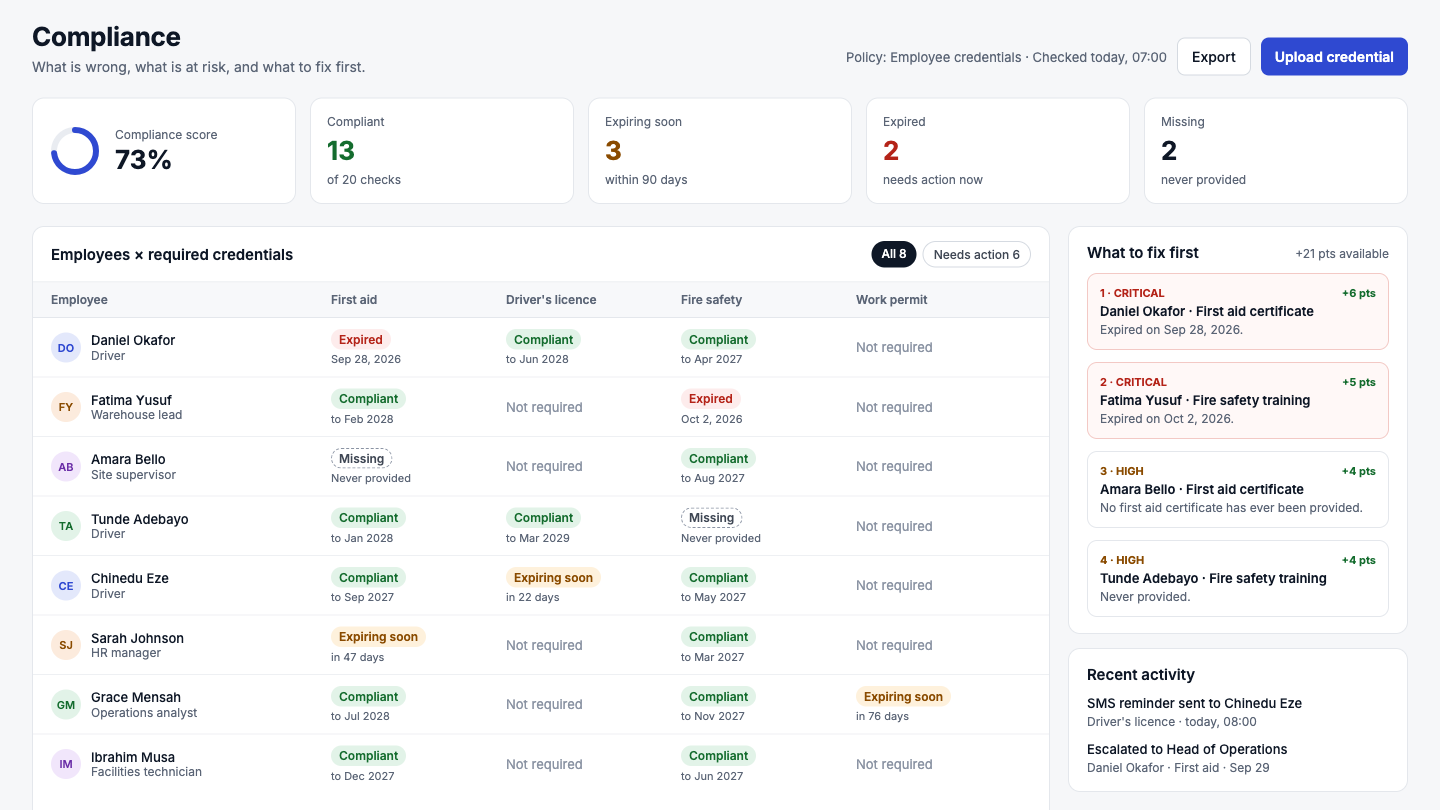
Imagine discovering during a compliance audit that a member of your team has been working with an expired professional licence. Or finding out that several employees have never submitted a certification required for their roles.
The problem may not be that your organisation lacks procedures. It may simply be that credential records are scattered across spreadsheets, employee files, emails and shared folders, with no reliable system for identifying what is missing or approaching expiry.
For HR managers, compliance officers and operations teams, this creates an important question:
How can you be confident that every employee holds the credentials required to perform their job?
The answer begins with employee credential monitoring.
This guide explains what employee credential monitoring is, why it matters, how to build an effective tracking process and how to prevent credential-related compliance gaps before they become operational problems.
What Is Employee Credential Monitoring?
Employee credential monitoring is the ongoing process of tracking, verifying and reviewing the licences, certifications, qualifications and other credentials employees need to perform their assigned roles.
It helps organisations establish which employees hold the required credentials, whether those credentials are current, when renewals or reassessments are due, and where important documentation is missing.
For example, an organisation may need to monitor:
Professional licences held by nurses, engineers, accountants or other regulated professionals.
First aid, health and safety, or other job-specific certifications.
Driving licences for employees whose responsibilities include operating vehicles.
Technical qualifications and industry accreditations.
Mandatory training completion and refresher requirements.
Other credentials required by law, professional bodies, contracts or internal company policies.
An effective monitoring process goes beyond recording expiry dates.
It connects four questions:
Requirement: What credentials must someone in this role hold?
Evidence: Has the employee provided the required credential, and has it been appropriately verified?
Validity: Is the credential current, expired, approaching expiry or in need of further review?
Action: Who is responsible for resolving a gap, and when must it be resolved?
Without answers to all four questions, an organisation may have a collection of employee documents without a dependable picture of workforce compliance.
Why Employee Credential Monitoring Matters
Organisations invest significant effort in recruiting qualified employees. Maintaining those qualifications throughout employment deserves equal attention.
Employee credential monitoring supports several important business objectives.
1. Reducing compliance risks
In regulated industries, certain responsibilities may only be performed by individuals who hold appropriate, current licences or registrations.
A missing or expired credential can create a compliance issue when the employee continues performing work that legally requires it.
The precise consequences depend on the jurisdiction, profession, applicable regulations and circumstances. They may include regulatory findings, restrictions on activities, contractual problems or enforcement action.
A good monitoring process helps identify potential problems early enough for the organisation to investigate and take appropriate action.
2. Improving workplace safety
Some employee credentials demonstrate completion of training or assessments related to workplace hazards.
For example, the US Occupational Safety and Health Administration (OSHA) requires employers covered by its powered industrial truck standard to ensure operators receive appropriate training and evaluation.
Under 29 CFR 1910.178(l), an operator's performance must be evaluated at least once every three years, with refresher training required in specified circumstances.
Importantly, this is an operator evaluation requirement, not a universal rule that every forklift certificate expires after three years.
It illustrates why organisations must understand the actual requirement behind a credential rather than assuming every qualification follows the same renewal schedule.
3. Avoiding operational disruption
Consider a logistics company whose employee needs a valid driving licence for a particular assignment.
If the licence expires without anyone noticing, the company may need to reassign the work while the issue is resolved.
Similarly, an organisation may have to delay a project because a required qualification is missing or cannot be verified.
Early monitoring gives managers more time to plan renewals, training, verification and temporary cover.
4. Supporting audit readiness
During an audit, a reviewer may ask an organisation to demonstrate that employees hold the qualifications required for their duties.
A structured credential register can help the organisation locate relevant documents, verification records, dates and follow-up actions.
However, simply having a record does not prove compliance. Records must be accurate, and organisations must perform whatever verification and oversight the applicable rules require.
5. Reducing administrative workload
Manual tracking often involves sending individual emails, searching through folders, updating spreadsheets and repeatedly asking employees for documents.
A consistent monitoring workflow makes it easier to identify the exceptions that need attention instead of reviewing every employee record from the beginning.
What Employee Credentials Should HR Teams Track?
There is no universal list of credentials that every organisation must monitor.
The right list depends on the employee's role, the organisation's industry, operating location, contracts and internal requirements.
Common categories include:
Credential category | Examples | What to monitor |
|---|---|---|
Professional licences | Nursing, engineering and other regulated professional licences | Licensing authority, status, expiry or renewal date |
Safety certifications | First aid, specialised safety qualifications | Completion, validity and refresher requirements |
Operational qualifications | Driving or equipment-operation qualifications | Relevant authorisation and reassessment dates |
Professional certifications | Industry or technical certifications | Certification status and renewal requirements |
Mandatory training | Role-specific compliance and safety training | Completion and required refresher dates |
Registrations | Professional registrations required for particular activities | Registration status and renewal conditions |
An important distinction: not every qualification expires, and not every training completion record needs to be renewed.
Some qualifications remain valid indefinitely. Others require periodic continuing education, competence assessments or renewal applications.
Your monitoring system should reflect the actual rules rather than applying an arbitrary expiry date to every credential.
The Hidden Risk: Missing Credentials, Not Just Expired Ones
Many organisations focus on expiry dates because they are relatively easy to record.
But some of the most important credential problems do not involve an expiry date at all.
Consider a new employee joining a construction company.
The company requires everyone assigned to a particular site activity to provide evidence of relevant safety training.
The employee's details are entered into the HR system, but the required certificate is never submitted.
If the organisation only tracks certificates that have already been uploaded, the employee may not appear on any expiry report.
There is no expiry date to trigger an alert.
The record is simply missing.
This is why employee credential monitoring must compare what an employee is required to hold against what the organisation actually has on file.
A useful monitoring process should distinguish between:
Compliant: The required credential is present and meets the applicable validity criteria.
Expiring soon: The credential is currently valid but approaching an important date.
Expired: The credential has passed its recorded expiry date.
Missing: No acceptable credential has been provided for an applicable requirement.
Stale or needs review: The available record may be outdated, incomplete or require further validation.
These distinctions allow HR teams to take appropriate action based on the actual problem.
An employee whose professional registration has expired may require a different response from one whose training certificate is merely awaiting upload.
How to Build an Effective Employee Credential Monitoring Process
An effective process does not have to begin with complicated software.
It begins with clearly defined requirements, reliable records and assigned responsibilities.
The following steps provide a practical starting point.
Step 1: Identify credential requirements for each role
Start by determining which credentials employees must hold to perform their responsibilities.
Requirements may come from:
Laws and regulations.
Professional licensing authorities.
Industry or accreditation standards.
Customer or contractual obligations.
Internal company policies.
Health and safety procedures.
For each role, document the applicable credentials and the reason they are required.
For example:
Employee role | Credential or requirement | Requirement source |
|---|---|---|
Nurse | Current professional licence | Relevant licensing authority |
Forklift operator | Appropriate training and competence evaluation | Applicable workplace safety requirements |
Company driver | Appropriate driving licence | Road traffic and licensing requirements |
Designated first aider | Relevant first aid qualification | Applicable workplace requirements or company policy |
These examples are illustrative; requirements vary by jurisdiction and role.
Where possible, record the specific source of each requirement. That makes it easier to verify the obligation and update your process when the underlying rules change.
Step 2: Create a central employee credential register
Once the requirements are defined, create a reliable record of the credentials held by each employee.
Useful fields include:
Employee name or internal identifier.
Job role and relevant work location.
Credential type.
Issuing organisation or authority.
Credential or reference number, where appropriate.
Issue date.
Expiry, renewal or reassessment date, where applicable.
Verification date and method.
Person responsible for verification or follow-up.
Current monitoring status.
Supporting document or verification evidence.
Avoid collecting unnecessary personal information simply because it appears on a credential.
The objective is to hold sufficient information for a legitimate business purpose, not to accumulate sensitive employee records without justification.
Step 3: Verify credentials appropriately
A scanned certificate is not always sufficient evidence that a qualification or professional licence is genuine and current.
Where required, organisations should verify credentials using the original issuing body, relevant professional register or another officially accepted verification source.
For example, The Joint Commission's guidance on primary source verification explains requirements that can apply to verifying professional licences, certifications and registrations in relevant healthcare accreditation settings.
Verification requirements vary. Not every internal training certificate requires the same process as a regulated professional licence.
A documented verification process should identify what was checked, who checked it, when it was checked and what the outcome was.
Step 4: Establish a credential renewal calendar
The next step is to identify upcoming expiry dates, renewals and reassessments.
A good renewal calendar should show:
Credentials approaching an important deadline.
The employee concerned.
The responsible HR representative or manager.
The applicable renewal requirements.
Any supporting training or documentation needed.
The action required to resolve the issue.
Do not assume that the expiry date is the ideal date to begin the renewal process.
If a professional renewal takes several weeks to complete, starting the process seven days before expiry may be too late.
Step 5: Set up advance reminders
Rather than relying on employees to remember every deadline, establish a consistent reminder process.
For credentials with longer renewal lead times, an illustrative reminder schedule might be:
Timing | Recommended action |
|---|---|
90 days before expiry | Review the renewal requirements and identify necessary actions |
60 days before expiry | Notify the employee and responsible manager |
30 days before expiry | Confirm progress and outstanding requirements |
7 days before expiry | Escalate unresolved issues where appropriate |
On expiry | Review validity and determine any operational restrictions |
This is an example workflow, not a statutory reminder timetable.
Your organisation should adjust the schedule according to the actual renewal process, operational impact and legal requirements.
For some credentials, preparation may need to begin much earlier.
Step 6: Assign responsibility for every renewal
A common reason for missed deadlines is unclear ownership.
An employee may assume HR is responsible for renewal. HR may assume the employee is handling it. The line manager may not know the credential is expiring.
Avoid this uncertainty by defining responsibilities.
A practical arrangement might be:
Employee: Initiates renewal, completes required activities and provides updated evidence.
HR or credential administrator: Maintains records, follows up and coordinates verification.
Line manager: Confirms that the employee meets role requirements and responds to operational risks.
Compliance team: Oversees significant compliance gaps and escalations where appropriate.
The important principle is simple: every outstanding action should have a clearly identified owner.
Step 7: Record completion and retain appropriate evidence
Receiving a renewed document should trigger an update to the employee's credential record.
The responsible person should confirm the updated credential details, complete any required verification, and record the result.
Useful evidence may include the updated certificate, licence details, verification confirmation or a documented assessment result.
Retention should follow applicable laws and organisational policies.
For example, the UK's Information Commissioner's Office guidance on employment records emphasises collecting only information that is necessary and retaining personal information no longer than justified.
Restrict access appropriately and establish retention periods for different record types.
Step 8: Review credentials when employees change roles
Credential monitoring is not only about time.
Requirements can change when an employee:
Joins the organisation.
Moves to another department.
Takes on new responsibilities.
Transfers to a different location.
Begins a new regulated activity.
Returns from extended leave.
Leaves the organisation.
A credential that was sufficient for one role may not meet the requirements of another.
Include credential reviews in onboarding, internal transfers, role changes and offboarding procedures.
Employee Credential Monitoring Example
Consider a fictional facilities management company with 60 employees.
Some employees perform administrative work, while others are assigned to activities requiring specific licences, training or qualifications.
During a credential review, HR identifies the following issues:
Employee | Credential | Finding | Required action |
|---|---|---|---|
Employee A | Driving licence | Expires in 45 days | Start renewal follow-up |
Employee B | Required first aid certificate | Missing | Obtain and verify evidence |
Employee C | Role-specific safety qualification | Expired | Assess restrictions and arrange resolution |
Employee D | Professional certification | Current | No immediate action |
Employee E | Training assessment record | Review overdue | Arrange the required assessment |
Without a structured monitoring process, these records may appear across several folders and spreadsheets.
With a role-based tracking process, HR can identify which issues require immediate attention and which can be managed through scheduled follow-up.
The organisation can then prioritise its response based on the legal requirement, operational risk and available evidence.
This is particularly important because an expired credential, a missing document and an overdue internal assessment are not necessarily equivalent risks.
Spreadsheet vs Employee Credential Monitoring Software
Spreadsheets can be an effective starting point for organisations with relatively few employees and straightforward requirements.
However, as an organisation grows, the limitations of a manually maintained spreadsheet become more apparent.
Capability | Manual spreadsheet | Dedicated monitoring software |
|---|---|---|
Record employee credentials | Yes | Yes |
Track expiry dates | Yes | Yes |
Send automatic reminders | Requires additional setup | Can be built into the workflow |
Detect missing required credentials | Requires maintained rules and checks | Can compare role requirements with available records |
Assign renewal responsibilities | Manual | Can be linked to tracked actions |
Attach supporting evidence | Often separate or linked | Can be associated with credential records |
Provide an overview of compliance gaps | Requires formulas and maintenance | Can provide status-based reporting |
Maintain a history of follow-up | Requires additional processes | May be recorded within the system |
The main difference is not simply whether software can store expiry dates.
It is whether the organisation can consistently answer:
Who is required to hold what, who currently meets those requirements, and what must be fixed?
A spreadsheet can answer these questions if it is carefully designed and maintained.
Dedicated monitoring software can reduce the manual effort involved in keeping that information current, particularly when requirements, employees and renewal dates change frequently.
How Remindash Helps Teams Monitor Employee Credentials
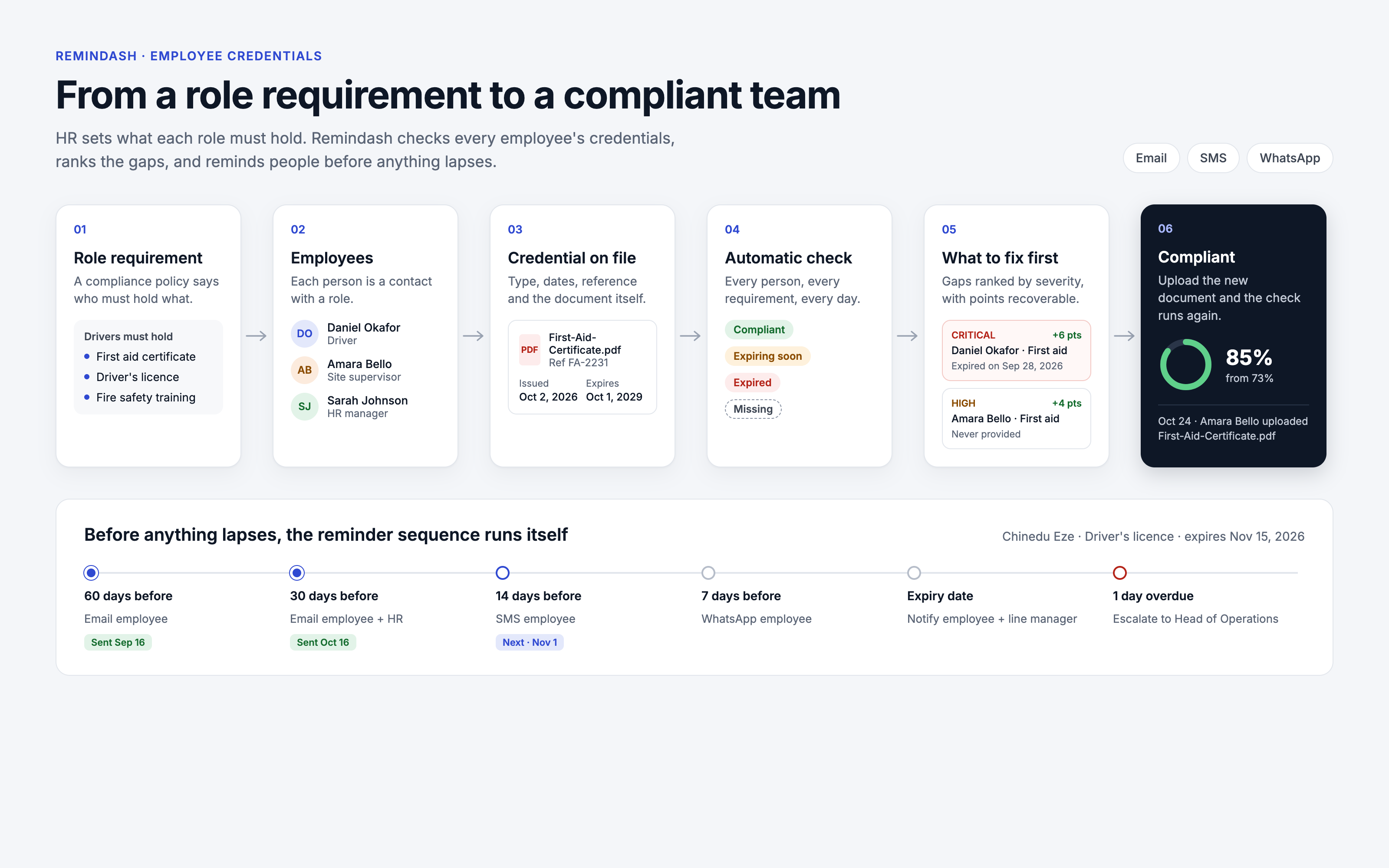
Remindash helps organisations connect employee credential records with defined requirements, monitoring statuses and follow-up workflows.
Instead of focusing only on a list of certificate expiry dates, Remindash is designed to help teams identify where an employee's available credentials do not meet a defined requirement.
Define what employees need to hold
In Remindash, organisations can establish compliance policies that specify required credentials.
For example, a company might define a requirement that employees assigned to a particular activity must hold a valid first aid certificate.
Remindash can then compare the applicable requirement against the credentials on employee records.
Keep credentials connected to employee records
Employee credential records can include the document type, issue and expiry dates, reference details and supporting file.
This makes it easier to locate the available evidence for an individual rather than searching through unrelated email attachments.
Identify missing and expiring credentials
Remindash presents credential monitoring outcomes such as compliant, expiring soon, expired, missing and stale.
It also provides reasons for failing checks and prioritisation based on severity.
This is useful because a missing document cannot be identified through expiry-date tracking alone.
A compliance overview helps teams identify which gaps need investigation, rather than treating every credential issue as equally urgent.
Follow up with reminders
Remindash also supports automated reminders and notification sequences.
Teams can configure reminder steps before important dates and notify the relevant people through supported email, SMS or WhatsApp channels.
Where an issue remains unresolved, follow-up and escalation can help draw attention to outstanding responsibilities.
Track related renewal obligations
For recurring requirements, Remindash Obligations provides a way to associate responsibilities with owners, deadlines, reminders and activity records.
This helps connect the credential record to the work that must happen before or after an important date.
Remindash does not replace the licensing authority, perform professional training or independently guarantee that an employee is legally qualified. Your organisation remains responsible for determining applicable requirements and carrying out required verification.
Its purpose is to make those responsibilities easier to monitor and manage.
Explore Employee Credential Management with Remindash or start for free.
Seven Common Employee Credential Monitoring Mistakes
Even organisations with established HR procedures can encounter avoidable problems.
1. Tracking expiry dates without tracking requirements
A database of submitted certificates does not reveal whether an employee has failed to provide a required document.
Better approach: Compare role requirements with employee credential records.
2. Treating every certificate as legally mandatory
Some certifications are required by regulation. Others are contractual, industry-specific or established by internal policy.
Better approach: Record the source, scope and applicability of each requirement.
3. Assuming all training certificates expire
Training completion, professional licence renewal and periodic competence evaluation can follow different rules.
Better approach: Verify the actual validity or reassessment requirement before adding a recurring deadline.
4. Leaving renewal responsibility unclear
Sending a reminder does not establish who must complete the work.
Better approach: Assign a responsible person and define an escalation path.
5. Waiting until expiry to act
Renewals may involve application processing, assessments, fees or additional training.
Better approach: Begin follow-up according to the time needed to complete the process.
6. Keeping evidence without verifying it
Having a document on file does not necessarily establish that the credential remains valid.
Better approach: Apply the verification procedure appropriate to the credential and relevant requirements.
7. Treating monitoring as proof of compliance
A dashboard showing current expiry dates cannot establish that an organisation has satisfied every applicable requirement.
Better approach: Use monitoring as one control within a broader compliance management process that includes verification, oversight and corrective action.
Employee Credential Monitoring Checklist for HR Teams
Use this checklist to assess your current process.
Requirements and records
We have identified the credentials required for relevant employee roles.
We understand the source of each requirement.
We maintain a central record of employee credentials.
We record applicable issue, expiry and reassessment dates.
We can identify employees who have not provided required credentials.
Monitoring and renewal
We periodically review the current status of credentials.
We have a clear process for verifying credentials.
We notify the responsible people before important renewal deadlines.
Each outstanding renewal or corrective action has an owner.
We have an escalation procedure for high-risk or unresolved gaps.
Compliance and evidence
We retain the evidence necessary to demonstrate credential status and verification.
We review requirements when employees change roles or locations.
We have a process for responding to expired or invalid credentials.
We protect employee records and apply appropriate retention periods.
Management can obtain a clear overview of outstanding credential issues.
If several of these items are unanswered, your organisation may benefit from reviewing its monitoring procedures.
The goal is not to create unnecessary administration. It is to establish a reliable process for knowing what is required and addressing gaps promptly.
How to Measure Whether Your Credential Monitoring Process Is Working
After establishing a monitoring process, review whether it is delivering useful outcomes.
A few practical measures can help.
Credential coverage rate
The percentage of applicable employee credential requirements supported by records that meet your defined criteria.
For example, if 100 credential requirements apply across your workforce and 94 have been satisfactorily met, the coverage rate is 94%.
This is an operational indicator, not a legal compliance determination.
Missing credential count
The number of applicable requirements for which acceptable evidence has not been provided.
Expired credential count
The number of required credentials that have passed their recorded expiry dates and remain unresolved.
Upcoming renewal workload
The number of credentials approaching renewal or reassessment within a defined period, such as 30, 60 or 90 days.
Time to resolve credential gaps
The average time between identifying a problem and confirming its resolution.
These measures are most valuable when they help managers make decisions.
A coverage percentage may be useful for an overview, but a single unresolved high-risk licence requirement can deserve immediate attention regardless of the overall score.
Frequently Asked Questions About Employee Credential Monitoring
What is employee credential tracking?
Employee credential tracking is the process of recording and maintaining information about employees' licences, certifications, qualifications and other required credentials. Employee credential monitoring goes further by checking their current status, identifying missing records and prompting action when renewals or reviews are needed.
What is the difference between credential monitoring and certification tracking?
Certification tracking focuses on certificates or professional certifications. Credential monitoring is broader and may include professional licences, registrations, training records, qualifications and other evidence required for specific roles.
How can HR track employee certification expiry dates?
HR teams can maintain a central register containing the employee, credential type, expiry date, responsible person and renewal status. Automated reminder software can help notify employees and managers before important deadlines.
How often should employee credentials be reviewed?
There is no single review frequency that applies to every organisation or credential. Reviews should reflect applicable laws, professional requirements, operational risk and internal procedures. Organisations should also review relevant credentials when employees join, change roles or take on additional responsibilities.
What happens when an employee's professional licence expires?
The appropriate response depends on the profession, jurisdiction and work being performed. HR and management should verify the licence status, assess whether the employee can lawfully continue relevant duties, and take any necessary corrective action. Do not assume that a pending renewal automatically authorises continued practice.
Can an Excel spreadsheet manage employee credentials?
Yes. A well-maintained spreadsheet may be adequate for smaller organisations with straightforward requirements. As the workforce grows, automated reminders, document management, requirement checks and clearer ownership can make dedicated software more practical.
Can software automatically verify that an employee is licensed?
Some specialised systems offer verification integrations, but credential tracking and authoritative licence verification are different functions. Organisations should not assume that uploading a document or marking an item current is equivalent to verification with a licensing authority.
Is employee credential monitoring only necessary for regulated businesses?
No. Even where a particular credential is not legally required, an organisation may need to monitor qualifications or training required by contracts, safety procedures, customer expectations or internal policies.
What is the best way to prevent employee credentials from expiring unnoticed?
Combine a reliable credential register with appropriate verification, advance reminders, clear ownership and regular reviews. Importantly, also identify missing credentials, because an expiry reminder cannot warn you about a document that was never recorded.
Final Thoughts: Move from Credential Records to Credential Readiness
Employee credential monitoring is not simply about storing certificates or remembering renewal dates.
It is about maintaining a dependable understanding of whether employees have the qualifications, licences and other credentials required for their work.
For HR and compliance teams, an effective approach brings together three essential elements:
Clear requirements. Reliable evidence. Timely action.
When organisations understand what each role requires, maintain accurate records and assign responsibility for unresolved issues, they are better positioned to address compliance gaps before they affect operations.
Whether you manage a small team or a growing workforce, the starting point is the same: know what each employee needs, know what is currently on file, and have a plan for anything that is missing or due for review.
Keep Employee Credentials and Renewals on Track with Remindash
Remindash helps teams monitor credential requirements, identify missing and expiring documents, and organise reminders and related obligations.
See which credentials need attention, understand why a check has failed, and give the right people a clearer path to resolving the issue.
Explore Employee Credential Management with Remindash →
Or start using Remindash for free →.
Sources and Further Reading
Disclaimer: This article provides general information on credential monitoring and is not legal advice. Professional licensing, employment, safety and recordkeeping requirements vary by location, industry and role. Consult the relevant authorities and qualified advisers when determining your organisation's obligations.
Get hands-on compliance support
Work with Remindash to turn requirements into an operational plan.
Explore managed compliance